The Sunday Reset That Takes Forty Minutes, Not Four Hours
Most weekly planning fails because it's built for a person with more evenings than you have. This version starts from the evenings you've actually got.
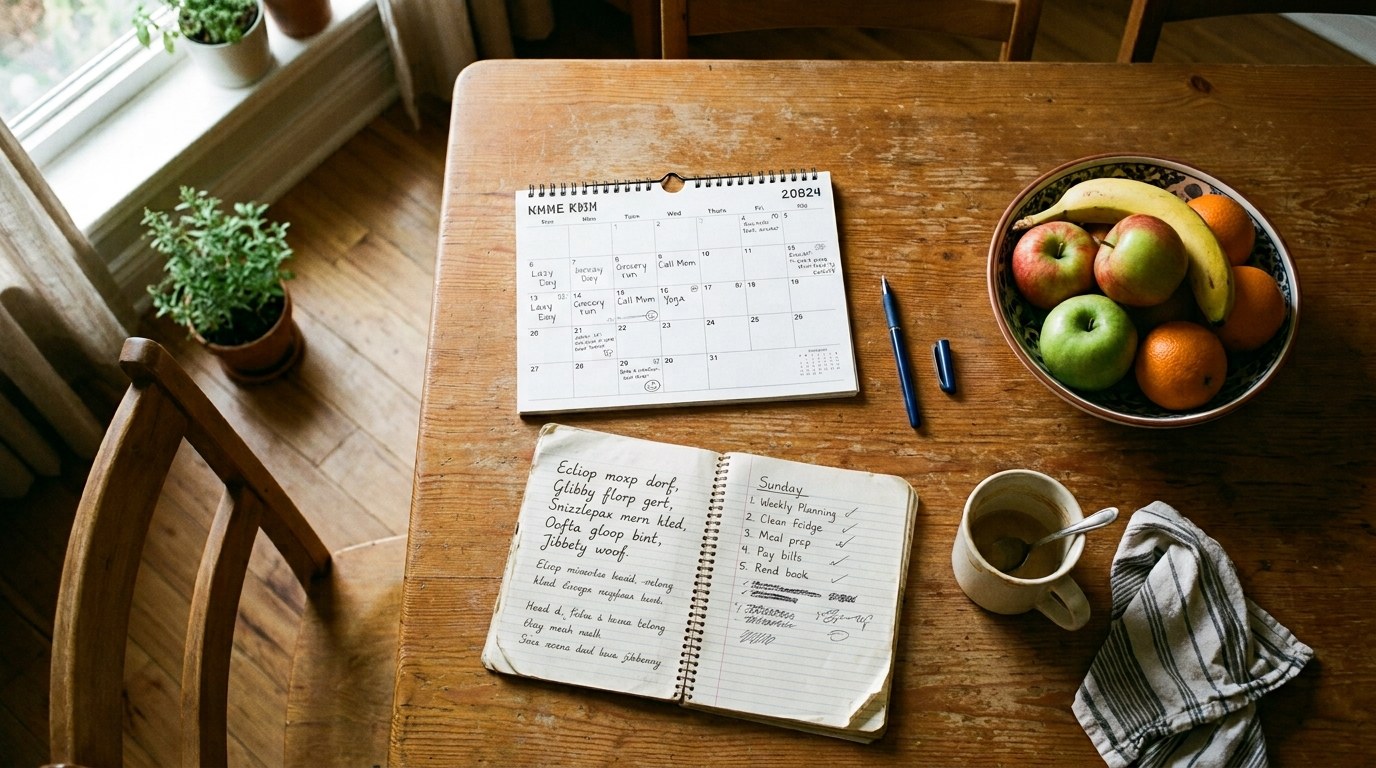
For about two years I did the thing where you sit down on Sunday afternoon with a beautiful notebook and plan the whole week: seven dinners, a color-coded calendar, a shopping list organized by aisle. It looked great. By Wednesday it was fiction. Something ran late, one dinner got skipped, the ingredients for Thursday went soft in the drawer, and the notebook quietly became a place to put receipts.
What finally worked was much smaller and, frankly, a bit boring. It takes about forty minutes, it uses whatever's already in the kitchen, and it has one rule: the plan is built around the evenings I actually have, not the evenings I'd like to have.
Step One: Count Your Real Evenings (5 Minutes)
Before anything else, look at the coming week and be honest about how many evenings are genuinely yours. Not "I'll probably be home by six." Actually yours, with nothing scheduled and nobody depending on you to drive them somewhere.
For most people the number is somewhere between two and four. That's fine. That's the number you're planning for. Everything that follows is scaled to it, and that's the difference between a plan that survives the week and one that dies on Tuesday.
Write the number down. Then write which nights they are. That's it for step one.
Step Two: Shop The Fridge Before The Store (10 Minutes)
Open the fridge, the freezer, and the one cupboard where things go to be forgotten. Make a quick list of what's actually there that needs using. Half a bag of spinach. The chicken thighs you froze. The rice that's been open a while. Three eggs. That jar of something.
Now plan dinners for your real evenings, starting from that list. Not from a recipe you saw. From what's there. You'll be surprised how often two or three of your evenings are already covered by things you'd otherwise let go off.
The remaining evenings, the ones you're out or late, don't get a plan. They get a fallback. Something you can make in ten minutes from pantry stuff, or a standing arrangement (leftovers, the good frozen pizza, eggs on toast). Naming the fallback in advance is the whole trick. Nobody decides well at 7:45pm with a hungry family.
A tip that sounds obvious and isn't: plan one meal that makes enough for two nights. That's one evening you don't have to think about at all, and it's usually the difference between the plan holding and the plan folding.
Step Three: One List, Not Three (10 Minutes)
I used to keep a grocery list, a hardware store list, and a "stuff to remember" list. They lived in three places and I'd forget to bring at least one of them. Now it's one list, split into three headings, on a single piece of paper stuck to the fridge or a single note on my phone.
Write the groceries first, based on the dinners you just planned and nothing else. Then anything for the house. Then errands. If you go to the store and there's a hardware run on the same list, you'll see it and probably do both trips in one loop.
The list should be short. If it's long, you've drifted from "what I need this week" to "what I'd like to have," and that's how the crisper drawer fills with intentions.
Step Four: The Thursday Problem (10 Minutes)
Every week has a day where too much lands at once. Usually it's Thursday, for reasons I've never understood. Look at that day now, on Sunday, while you're calm.
Ask three questions:
- Which of these things can move to another day?
- Which of these things can someone else do?
- If none of it moves, what gets dropped?
Decide now. Move the thing that can move. Text the person who can take the other thing. And if something has to give, pick it on Sunday, not on Thursday at 4pm when you're already behind and every option feels like failure.
A plan that ignores your real constraints is a plan you've abandoned by midweek. Worse, you've now also decided you're the kind of person who abandons plans. Building the constraints in from the start avoids both.
Step Five: Five Minutes For The Pile
You know the pile. Letters, a form, the thing you keep meaning to cancel. Don't try to clear it. Pick one item, the most annoying one, and put it on the list for one specific evening. That's all. One thing, one night.
Over a month that's four small annoying things gone, which is roughly the whole pile, and it never took more than a few minutes on any single night.
Where Tools Help, And Where They Don't
People ask whether an app or an AI assistant makes this faster. Honestly, a bit. If you hand one your real constraints, "three free evenings, these ingredients, one meal that stretches to two nights, one night out," it'll draft a reasonable week in seconds, and it's decent at turning that into a single tidy list.
What it can't do is know your constraints unless you tell it. Ask for "a meal plan" and you'll get seven ambitious dinners for a person with seven free evenings, which is the exact plan that fails. The value is entirely in the framing, and the framing is steps one and two above. We went into this in more detail, along with a few other everyday jobs, in this piece on what people actually use AI for at home. The meal-plan point is number three.
What Forty Minutes Buys You
It isn't a perfect week. Nothing buys that. What it buys is a week with fewer 7:45pm decisions, fewer soft vegetables, one fewer trip to the store, and a Thursday you saw coming.
And if a week goes sideways anyway, which some will, the reset is forty minutes next Sunday. Not a system to rebuild. Not a notebook to feel guilty about. Just a pen, the fridge, and an honest count of your evenings.